By Amy Katz, Conservation Director
Why here? This is a question I’ve become accustomed to answering over the years when describing Heart of the Rockies Initiative’s sweeping, transboundary service area.
And it’s a valid question: There are many beautiful, important landscapes in North America, each with its own unique conservation values. As someone who grew up in southern Colorado, I have a deep appreciation for the sandstone deserts of the Southwest. I am married to a New Englander and have come to love the cold, rocky shores of Maine and the old stone walls that border backroads between rolling farms in the Berkshires.
And yet, when we as a collective conservation community need to prioritize resources to maintain biodiversity, I’d still offer that it’s hard to argue that the Transboundary Rocky Mountains are not, well, where it’s at. Charismatic mule deer, pronghorn, grizzly bear, and wolverine feel the allure of large, uninterrupted, topographically diverse spaces that anchor our Heart of the Rockies service area, which spans from Banff National Park in the north, all the way down to the Uinta Mountains of northern Utah.
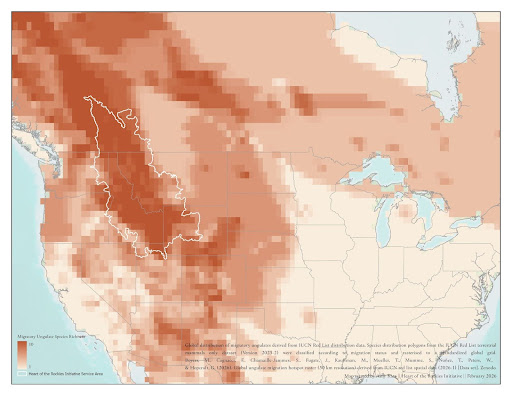
This region is home to more large mammals than anywhere in North America. The British Columbia Commission on Resources and the Environment found that the landscape ranging from the Flathead Valley up into southern British Columbia’s Elk River Valley supported more wild ungulates and large carnivores than anywhere else in North America, emphasizing that the region’s “large mammal predator prey systems and sizeable grizzly bear population are of international significance.” (CORE 1994). Sixteen carnivore species, to be specific, are found in this area — a number that Dr. John Weaver claimed to be unmatched in North America – and 10 migratory ungulate species, according to a recent International Union for Conservation of Nature (IUCN) dataset (Weaver 2001; Boyer et al. 2026; see Fig. 2).
To visually represent this striking statistic, I recently created a new map reflecting species ranges from the IUCN, overlaid with our service area boundary. Specifically, I was interested in the large mammals that we most often talk and think about within the Keep It Connected program, including: grizzly bear, black bear, gray wolf, bobcat, mountain lion, wolverine, lynx, caribou, pronghorn, mule deer, elk, bison, moose, and bighorn sheep. Unsurprisingly, our service region lights up, and only within our boundary and slightly to the north do we see more than eight of these species residing in one place (Fig. 1).
As I was working to create this map, Boyer et al. published a similar dataset, providing global-scale migratory ungulate species richness derived from the same IUCN Red List spatial distribution data. This, too, reinforced the importance of the Transboundary Rocky Mountains, with equivalent species richness only present in southern Africa and small parts of Asia and Scandinavia (Fig. 2).
My hope is that these maps inspire our land trusts, our funders, and our Keep It Connected team as we continue to do strategic, meaningful conservation work. And in a world that is constantly losing species and wildness, I hope they can remind us how lucky we are to live in a place that still remains magically wild.
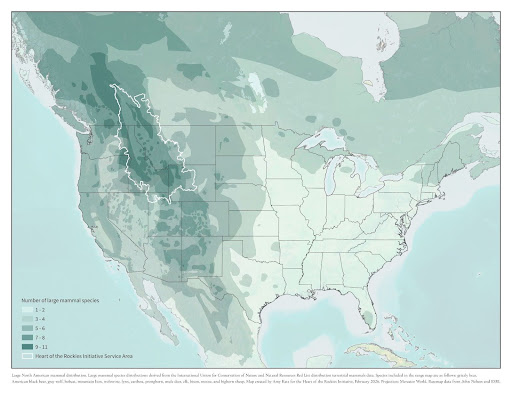
Figure 1 (above): Large mammal species range overlap in North America, with the Heart of the Rockies service area boundary in white.
Figure 2, a (below): Species distribution of migratory ungulates derived from IUCN Red List data, showing the global significance of the Rocky Mountain West of North America.
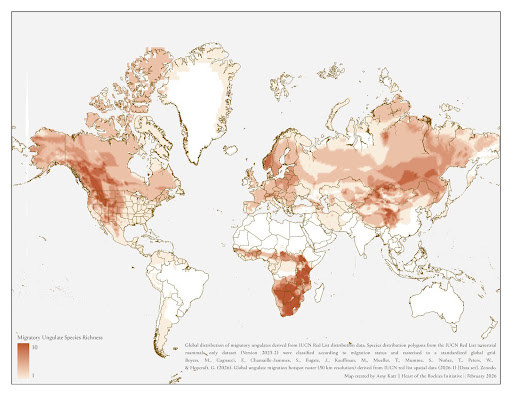
Figure 2, b (below): Species distribution of migratory ungulates derived from IUCN Red List data, showing he regional importance of the Heart of the Rockies service area.